

I’m starting to realize something about change.
People say “you’ve changed” to me like it’s a problem.
Like it’s something that needs to be corrected.
Like the goal should be to return to the version of myself they were most comfortable with.
But humans evolve. It’s literally built into us. Life reshapes you. Responsibility reshapes you. Duty reshapes you. Survival reshapes you.
Once you’ve lived through certain experiences — war, caregiving, crisis, rebuilding — you see patterns differently. And once you see them, you can’t unsee them.
That’s where the past becomes the receipts.
Not as ammunition. Not as a way to attack anyone. But as evidence of the life you actually lived. Evidence of the roles you carried, the systems you were part of, the expectations you absorbed because that was simply the environment you were in.
For me, those systems weren’t just one thing. They were layered.
The family I was born into.
The military life I married into.
The war-era family responsibilities that came with it.
The caregiving and advocacy roles that followed.
All of those systems run on similar values: loyalty, duty, sacrifice, and the expectation that you keep carrying the weight quietly because that’s what responsible people do.
For a long time, I believed that was simply what life required. But something I’m starting to understand now is that duty was never supposed to mean losing yourself.
Duty can ask a lot from a person. But when the expectations inside a system start to erase your identity, your voice, or your autonomy, something inside you eventually pushes back.
That’s where boundaries show up.
From the inside, boundaries feel like growth. They feel like clarity. They feel like finally standing in your own life instead of performing the role you were assigned.
From the outside, especially to the people who were comfortable with the old version of you, boundaries can look like rejection.
And that’s why hearing “you’ve changed” can land hardest when it comes from the people who knew you first — the family you were born into, or the communities built around shared sacrifice like military and veteran life.
Those systems remember the version of you that carried everything without question. But adulthood eventually brings a realization that no one prepares you for.
You can grow. You can become more honest about who you are. But you cannot force another person to evolve with you.
Sometimes relationships adjust. They stretch and find a new shape. Sometimes they don’t.
And when they don’t, the becomes learning how to live with that truth without shrinking yourself back into the person you used to be just to keep the peace.
Because if we’re being honest, growth was never the problem.
Choosing not to grow is.
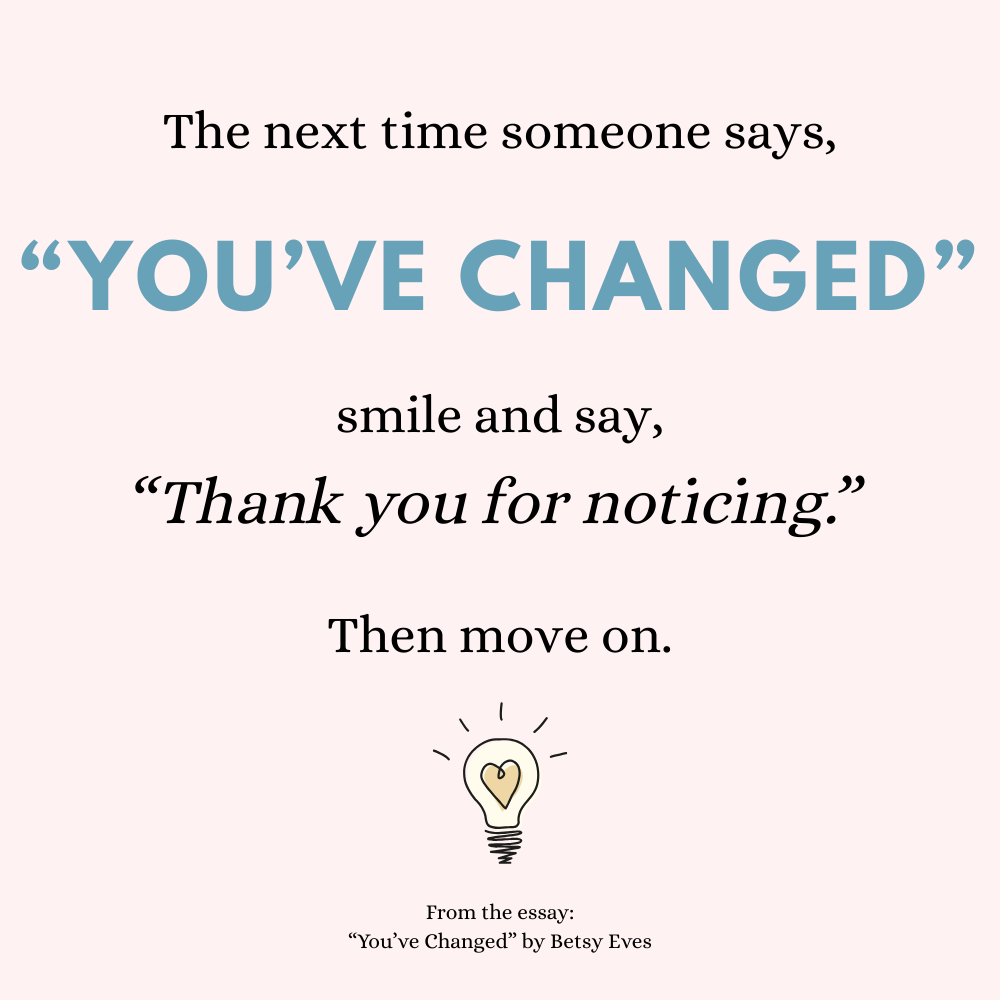
Remember, the next time someone says to you, “You’ve changed,” smile and say, “Thank you for noticing.” Then move on.
Read more: This reflection is part of a larger story — one that didn’t start here.
If this resonates, these pieces sit alongside it:
→ The End of an Era
Where I stopped carrying what was never mine to hold — and chose truth, safety, and no contact.
→ Recipes for Reform
Where I name the patterns after they’ve been lived — so people stop wondering if it was “just them.”
→ Military Family Healing Journey
What war, caregiving, and survival actually do to a person — and what it takes to rebuild after.
→ Rock Island Farm
What healing looks like when it finally becomes quiet, grounded, and real.
Different chapters. Same life. Same thread.


I started writing down one thing at the end of every day — what I actually managed to do. Not a to-do list, not plans. Just one small win. It’s surprising how quickly it shifts your perspective.